Algorithm Design with Concepts, Ranges, and Projections
Introduction
In this post, we will use the well-known insertion sort algorithm as a case study in the design of generic algorithms.
We will explore how concepts, ranges, and projections, introduced in C++20 and further developed in subsequent
standards1,2,3,4, can be used to develop a flexible generic implementation of the
algorithm, capable of operating on a variety of sequence containers such as std::vector and std::list. For readers unfamiliar
with these features, we begin with brief working definitions, which will become clearer as we use them throughout the article:
A range designates a sequence of elements, potentially unbounded, over which a computation is to be performed through iteration. It is specified by an iterator and a sentinel denoting the beginning and end of the computation, respectively. The sentinel need not have the same type as the iterator.
A projection is a transformation applied by an algorithm to an element before its value is inspected.
Insertion sort
Let R be a range to be sorted according to a given binary predicate comp, which
must induce a strict weak ordering on the values being compared. That is, we assume that comp
satisfies the following properties:
- Irreflexivity:
comp(a,a)is false for everya. - Transitivity:
comp(a,b)andcomp(b,c)implycomp(a,c). - If we define
equiv(a,b)as!comp(a,b) and !comp(b,a), thenequivmust also be transitive:equiv(a,b)andequiv(b,c)implyequiv(a,c).
Consequently, equiv partitions the elements into equivalence classes, on which comp induces a strict total ordering.
Let us assume that the range R contains at least two elements, denoted in order of occurrence by r₀, r₁, ....
This notation does not imply random access.
During its first iteration, insertion sort must order the first two elements of R,
that is, if comp(r₁, r₀) evaluates to true, the two elements must be swapped;
otherwise, they remain in their original positions. Next, we insert the third element, r₂ (if it exists),
into the correct position within the already sorted subrange {r₀, r₁}. At this point, the first
three elements of R are correctly ordered. We then insert the fourth element, r₃ (if it exists), into its
proper position with respect to the already sorted subrange {r₀, r₁, r₂}, and so on
until the entire range R has been sorted.5
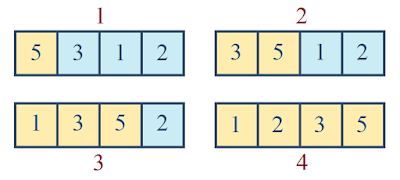
The following figure shows, from left to right and from top to bottom, the successive iterations involved
in sorting the sequence R = {5, 3, 1, 2} in ascending order:
std::ranges::sort will usually be a more appropriate choice. Interestingly, implementations
of standard sorting algorithms commonly use insertion sort internally to handle small subranges.
Let us consider a half-open range R = [first, last) to be sorted using insertion sort,
where first is an iterator of type I and last is a sentinel of type S (which need not be the same
type as I, as we shall see in a later example). Let proj denote a projection to be applied to the
elements of the range. It may, for example, be a function object or a pointer to a data member.
As we have already mentioned, a projection allows the algorithm to apply transformations to range elements
before comparing their values. This makes it possible, for instance, to sort objects according
to the ordering of one of their data members. Let comp denote the binary predicate evaluated on the projected values of
the range elements. The range R is said to be ordered with respect to comp and proj if, for every iterator i referring to
one of its elements, std::invoke(comp, std::invoke(proj, *std::ranges::next(i, n)), std::invoke(proj, *i)) evaluates to
false for every positive integer offset n such that std::ranges::next(i, n) still denotes a valid element of the range.
std::invoke is justified in
this generic programming context by the variety of callable entities that may be used to represent comp
and proj, including function objects, function pointers, and pointers to members.
We shall introduce the following interface for the insertion_sort algorithm, making the constraints imposed on its
argument types explicit. In what follows, we will use the using namespace std; directive throughout the code to improve
readability:
As we can see, we have specified a number of constraints both within the template parameter list
(enclosed in angle brackets) and through the requires clause. In order of appearance:
- The iterator type
Imust model at least thestd::forward_iteratorconcept. In particular, it must be copyable and incrementable (++), dereferenceable when it denotes an element, and support multiple independent passes over the same range. Note thatstd::forward_iteratordoes not require the iterator to support modification of the elements it refers to; that requirement is imposed separately bystd::permutable(see below). - The type
Smust modelstd::sentinel_for<S, I>, allowing a value of typeSto denote the end of a range whose iterator type isI. In particular,Smust be semiregular, and objects of typesIandSmust be weakly equality-comparable. One of its semantic requirements is that, wheneverbool(first != last)evaluates totrue,firstmust be dereferenceable, and incrementing it must leave[first, last)as a valid range. As noted before,Sneed not be the same type asI. - The types
I,Comp, andProjmust jointly model thestd::sortableconcept6, which is defined as the conjunction of the conceptsstd::permutableandstd::indirect_strict_weak_order(see the listing below). Among other requirements,std::permutableensures that the iterator type supports the indirect movement, storage, and swapping of elements needed to rearrange them. Meanwhile,std::indirect_strict_weak_orderrequires the comparison predicate to induce a strict weak ordering on the projected elements.
Comp can be used as a predicate and that the required expressions are well-formed, but it
cannot verify the semantic requirements of a strict weak ordering (including irreflexivity, transitivity, and transitivity of
the induced equivalence relation), which must therefore be ensured by the programmer.
Omitting namespace qualification for clarity, std::sortable is defined essentially as follows:
std::iter_value_t<I> to be copyable.
Copyability would be a stronger requirement than necessary and would prevent the algorithm from supporting
move-only types. We may wish, for example, to sort exclusive-ownership smart pointers such as std::unique_ptr
according to the values of the objects they own, a case that we will examine later.
The default sorting policy adopted by the insertion_sort algorithm is provided by std::ranges::less,
while the default projection is the function object type std::identity, whose operator() returns
its argument unchanged.
When generating a specific instance of the function template, the compiler will verify that the supplied
template arguments satisfy the stated constraints, issuing a meaningful diagnostic message otherwise.
Our version of the algorithm can operate on a wide variety of iterators, including the forward iterators of
std::forward_list, the bidirectional iterators of std::list, and the contiguous iterators of containers
such as std::array and std::vector:
Next, we shall implement the body of insertion_sort as a composition of well-known standard
algorithms.7,8,9,10 This provides a direct and concise formulation
that supports forward ranges:
First, we take into account that if the range to be sorted, [first, last) , is empty
or contains only a single element, the algorithm can terminate immediately. The compiler selects the
first branch (A) when S and I model std::sized_sentinel_for (as is the case, for example, for a pair of
random-access iterators), in which case their distance can be obtained in constant time. Otherwise, the second
branch (B) is used. This is typically the case, for example, with iterator pairs from std::list or std::forward_list.
At the beginning of each for loop iteration, the subrange [first, i) is sorted. The current element,
denoted by i, is then inserted into its proper position, after which [first, std::ranges::next(i)) is sorted.
To locate the insertion position j, we distinguish two strategies according to the capabilities of the iterator type:
Imodelsstd::bidirectional_iterator: the sorted subrange[first, i)is traversed in reverse order, starting from the element immediately precedingi. Thestd::ranges::find_if_notalgorithm (C) stops as soon as it finds an element that the current element does not precede according tocompandproj. Thebase()member of the resulting reverse iterator then yields the position immediately after that element.Iis only a forward iterator: thestd::ranges::upper_boundalgorithm (D) performs a binary search on the sorted subrange[first, i)to locate the insertion position.
In either case, the resulting iterator j denotes a position after any previously processed elements equivalent to the
current one according to comp and proj. More precisely, !bool(std::invoke(comp, std::invoke(proj, *i), std::invoke(proj, *k)))
evaluates to true for every iterator k in the subrange [first, j).
The std::ranges::rotate algorithm (E) then moves the element denoted by i to position j by means of a cyclic
permutation of [j, std::ranges::next(i)).

We shall also provide an overload of the algorithm that operates directly on a range, rather than on the iterator-sentinel pair used by the first version:
In this version, we require the type R to satisfy the std::ranges::forward_range concept and
subsequently require the range iterator type std::ranges::iterator_t<R>, the comparator type Comp,
and the projection type Proj to satisfy the std::sortable concept.
Example 1: Movable but non-copyable elements
The following code shows how the previous algorithm can be used to sort an array of movable but non-copyable elements,
in this case std::unique_ptr<int> smart pointers. The comparator, defined as a lambda expression, takes two such pointers
and dereferences them to establish the natural ordering of the integers they point to:
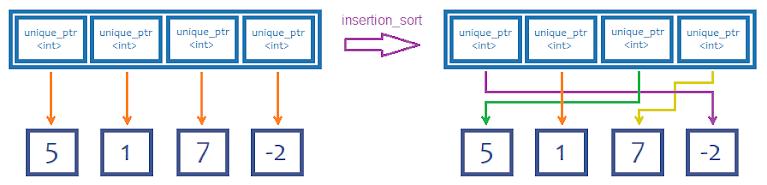
The memory layout of the array in the example would follow a scheme like the one below, before and after sorting, with ownership of the managed integers being transferred as the smart pointers are moved:
Alternatively, the array could be sorted using a projection that dereferences the pointers:
Example 2: Projections
As we have seen, projections allow the sorting algorithm to specify which value derived from each range element is
to be used for comparison. As a further example, the following simple code sorts a vector of Book objects
according to one of their public data members, price, using the std::ranges::greater function object to sort the
books in descending order:
Example 3: Sentinels
The following example sorts a C-style null-terminated string and illustrates a situation in which
the iterator type I (a char*) and the sentinel type S (named Zstr_sentinel) are different:
Here, the null character belongs to the underlying array but acts as the end marker, and is therefore
not part of the range being sorted. A more detailed explanation of the Zstr_sentinel type is available
in the literature.11
Example 4: Compile-time sorting
We will conclude this article by putting C++’s compile-time computation capabilities to the test once again. The reader will no doubt have noticed that the insertion_sort overloads have been declared constexpr. This allows them to be evaluated at compile time when invoked in a context that requires a constant expression.12
As an example, let us define the following Sorted_array<T, N, Comp, Proj> class template, which publicly inherits from std::array<T, N>. Given an array rvalue, a comparator, and a projection, the class constructor will store and sort the data by calling insertion_sort:
Let us consider the following simple program:
The generated x86-64 assembly (compiled with GCC 16.2 using -O3 and -DNDEBUG) shows that the sorting of entries has been
completed at compile time; its elements already appear in descending order, and no run-time sorting code is generated:13
Interestingly, the Clang 23.1.0 compiler is able to unroll the for loop used for printing and produce
a sequence of calls to printf.14 Such a transformation may improve execution speed in some circumstances,
at the cost of increasing the size of the generated code:
Note: This post is a translated and expanded version of an earlier article that I originally published in Spanish on Blogger: Programando con C++20 (Parte I): Concepts.
Bibliography
-
cppreference.com - Constraints and concepts ↩
-
cppreference.com - Concepts library ↩
-
cppreference.com - Iterator library ↩
-
cppreference.com - Rages library ↩
-
Cormen T. H., et al., Introduction to Algorithms. 3rd Edition, MIT Press (2009). ↩
-
cppreference.com - std::sortable ↩
-
cppreference.com - std::ranges::find_if_not ↩
-
cppreference.com - std::ranges::upper_bound ↩
-
cppreference.com - std::ranges::rotate ↩
-
Stack Overflow - How to implement classic sorting algorithms in modern C++? ↩
-
foonathan::blog() - C++20’s Iterator Sentinels ↩
-
cppreference.com - Constant expression ↩
-
Compiler Explorer - Article’s code (compiled with GCC) ↩
-
Eric Niebler - Quicksort of an array of ints at compile-time using C++17 constexpr ↩